Showing posts with label D. Assignment 3: Factual Programming.. Show all posts
Friday, 16 June 2017
Thursday, 8 June 2017
Monday, 5 June 2017
The nature and purposes of research in the creative media industries.
Primary Research:
Primary research is research that is gathered yourself, for example: Interviews, surveys and questionnaires. For my documentary, we interviewed numerous people about the subject of our documentary, which was tattoos. And we sent out a survey for our whole class to answers, in which we got answers and information off that. An advantage of primary research is that primary research has more reliability as you have gone out and collected the research yourself, so you can trust the information. A disadvantage would be that there is limited info you can gather. Here are a few examples of primary research from our survey:
Secondary Research:
Secondary Research is research that is collected from other existing pieces of work. For example: going onto the internet and gathering data off websites, this counts as secondary research as the website already as information on it and you are taking data from it. For our secondary research, we used websites like Wikipedia to get a general overview of tattoos and their history and looking at the different types of tattoos there are. An advantage of secondary research would be that there is a lot of different info available, especially on the internet. And a disadvantage for secondary research would be that the info that you gather is not going to be as reliable and you cannot always trust anything you obtain off the internet. Examples of this would be:
Quantitative Research:
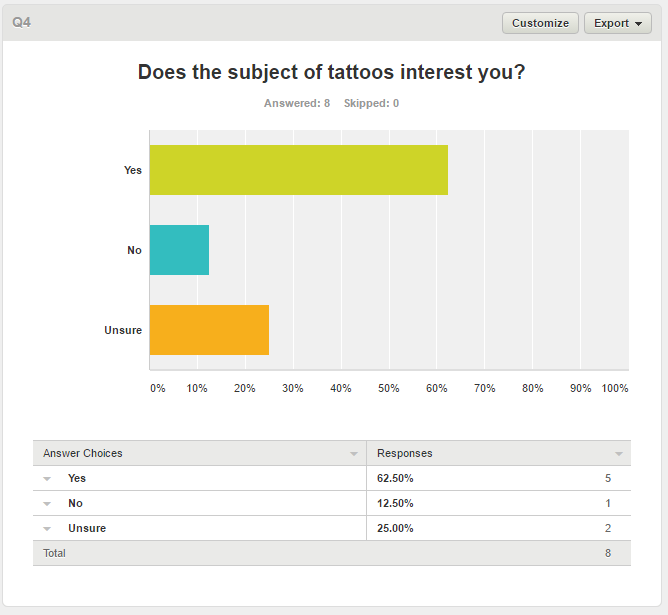
Quantitative Research is research and data that is collected and gathered in numbers. For example: things like programme ratings, hits on a website, box office figures and sales on CD's and DVD's. Quantitative data is a lot easier to understand as at a quick glace you can clearly see what the dtata or info is showing. However you will not be able to get worded info out of this, that would be a disadvantage. Part our survey that we had created and sent out to our class is classed as quantitative research, for example:
This is quantitative research as there is a percentage mark on the total of responses at the bottom.
Qualitative Research:
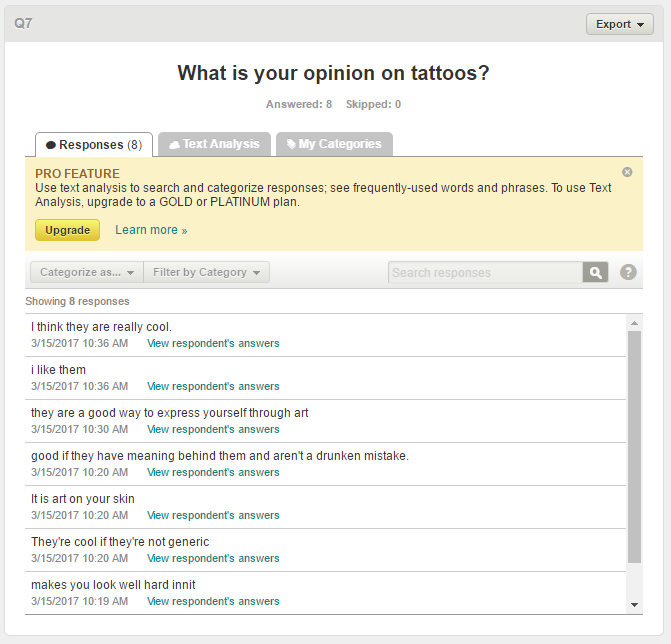
Qualitative Research is worded data. An example of qualitative data would be: Film reviews, game reviews, attitudes to media products, responses to news coverage, responses to advertising campaigns and discussions. Qualitative research is great for gathering information on knowing what went well on a certain project and gaining other peoples feedback on how you could do better. Although sometimes all of the worded data could be difficult to understand and will take longer to read. For my documentary our qualitative research was our survey, we put questions in that had to be answered using sentences. Here are some examples:
Data Gathering Agencies:
Data Gathering agencies are companies that collect an abundance of data and put it online. For example: IMDb is a website that collects data about films, the people who are involved in making the film, and even the the actors who play in the film, and put that info on their website so people can read about it. BARB is the organisation that compiles audience measurement and television rating in the UK. BARB will register houses which are more commonly known as 'panel houses' and in every one of those houses there is a meter that is attached to the TV and electronic devices. Because not everyone has a meter in their TV there are certain people who are representatives of the UK's viewership. This allows BARB to know who is watching what at any time during the day. Here is an example of BARB:
Audience and Market Research:
Audience research is data that is collected from a certain group of people or an audience. For our documentary we had to audience and market research. An example of audience research would be our survey that we had sent out. The whole purpose for this is to get advice and feedback from the general public and your peers to know what to do better and know how to improve anything. And to even more ideas. In our advertising unit, we had to re-brand a product from Unilever. And we had to do a re-branding pitch in which we would show our idea to the class, and then after we were given feedback and advice. Getting feedback and getting people to answer the survey is audience research.
Market research is gathering info and data from other peoples research that has already been conducted and put online. For our documentary we only had audience research.
Production Research:
Production Research is research to help give information on the characteristics of the product. In terms of production research there wasn't too much to take into consideration. The documentary was made to be placed in between a show in channel 4. It did not cost anything to make but if any equipment was to be damaged we would have to pay for the damage done, thus it would have cost a lot. The only technological resources used were our filming equipment which was a camera and a tripod. We had a few people in our documentary, all of which were interviewed. Finally, the documentary was shot in 2 locations, my home, and at a tattoo studio. Here is an example of the talent release that had to filled in, so we could continue.
Thursday, 25 May 2017
Is TV News a "window on the world"? Assignment.
In this assignment I am going to be answering the question: Is TV News a "window on the world?" And will be discussing whether or not the news is impartial, and putting my views on the matter, and will determine whether or not the news stays impartial like the law requires, or does it really only show us the things they want us to see.
TV News starting sequences always try to suggest that we are watching a raw, unmediated and impartial view on the world. They do this by using various different techniques that connote different things, for example:
In TV news starting sequences we often see transparent objects and eyes. These both connote neutrality. This means that nothing has been changed and nothing is hidden from the viewer. This also means that the news has not been edited what so ever, so what ever the news reporters see, the viewers also see. The transparent letters are like this 'window on the world'.
OFCOM regulations state that "News, in whatever form, must be reported with due accuracy and presented with due impartiality." TV News is always supposed to present with accuracy and impartiality but that is not always the case, here is why.
When we look into this case with more detail, we realize that this is not quite true.
There was once two men by the names of Galtung and Ruge. In 1973 they worked out 12 of the most significant news values, some of these values show that the news does not show impartiality, for example:
Frequency - this means that events like robberies and murders are usually used and preferred over larger, long term events like famine or poverty. This straight away goes to show that the news could be hiding the bigger problems that are happening in the world, and instead are just showing the same things over and over, stories that people have seen before so many times.
Un-ambiguity - meaning that news stories and events don't have to be simple but have to be accessible to the public which means that the media has to simplify the story in some way to which people can understand what is happening. This can be bad as this gives the media the chance to take out important parts of the story that the public will never know about, thus not showing impartiality or accuracy.
Reference to elite nations - The news covers a wide range of stories from all over the world, and mostly from more developed and 'important' countries in the world. You do get news stories about what is happening in the regions such as Africa, but not very often. This shows that a lot of stories about famine, and/or poverty in areas such as Africa are not made aware to the public and can be kept hidden.
Another reason I do not believe the news is being impartial is because of how they select their news stories, and what process they go through to get them. The 'gate-keeping' system was the term Galtung and Ruge used to refer to decisions by news producers made to select or discard certain or potential news stories. This is how the 'gate-keeping' process works. Stories have to go through a certain process before they appear on TV, but not every story will. A lot of stories may get queued up to go onto TV but are then last minute thrown away into what we call 'The Dustbin of History'. This shows us that not all of the stories are shown on TV and that because they are just discarded, we won't every hear of that story or even ever known it had existed in the first place. This in itself shows how the News is hiding things from the general public and are not always showing us everything as they should be. Economics is something that is very important when it comes to the gatekeeping process, some stories will get cut from TV depending on what financial time of year it is. If a certain News company have no money left to cover a specific story they may end up having this story become extremely short and not cover it in enough detail like another company with enough money would. For example: When the Tianmen Square Massacre occurred, ITV had spent the majority of their money on getting crews out there and in the end did not have enough money to cover the story and just had to cover it with a phone call, whilst the BBC had footage and reporters reporting out there. So the audience for the ITV news did not get to see what really happened, and just had to reply on voices. Competition is another big thing in the TV News industry, all of the News companies are always competing to get to a certain story first so they are the first ones to cover it and to get it on TV. But there is one problem, once one company finds a big story, other companies will then try to get there too, and so any companies that are left will also try to cover the story first and so eventually every company on TV will be covering the same story and no one will be watching anything new, instead all seeing the same old story.
During the news sometimes there can be technical issues, and so the news reporters or news presenters are told to keep talking until the problem is fixed. As the news is live this can be difficult to do because eventually they have ran out of things to say and will start to lose it and talk about random, unrelated things.
Most of the stories that you see on TV are usually shaped and changed from what they originally were. The news seem to be shaping the "reality" that we see on the world. And so we will never really know what is happening in the world to its full extent. This further backs up my point that the media and news are always changing what we see and will always continue to do so.
So in conclusion, I believe that TV news is a "window on the world" because a lot of things can be shut off from the public and we are not seeing what we really should be seeing. The news is always constructing what we see and even though the law states that they must show an unmediated view on the world and has to be reported with due accuracy and shown with due impartiality.
TV News starting sequences always try to suggest that we are watching a raw, unmediated and impartial view on the world. They do this by using various different techniques that connote different things, for example:
In TV news starting sequences we often see transparent objects and eyes. These both connote neutrality. This means that nothing has been changed and nothing is hidden from the viewer. This also means that the news has not been edited what so ever, so what ever the news reporters see, the viewers also see. The transparent letters are like this 'window on the world'.
Some news starting sequences are from or have been from space. This connotes that the news is going to cover stories world wide from around the globe.
In the TV News industry, even the law requires that the news must be impartial. Here is some of the legislation to show this:
OFCOM regulations state that "News, in whatever form, must be reported with due accuracy and presented with due impartiality." TV News is always supposed to present with accuracy and impartiality but that is not always the case, here is why.
When we look into this case with more detail, we realize that this is not quite true.
There was once two men by the names of Galtung and Ruge. In 1973 they worked out 12 of the most significant news values, some of these values show that the news does not show impartiality, for example:
Frequency - this means that events like robberies and murders are usually used and preferred over larger, long term events like famine or poverty. This straight away goes to show that the news could be hiding the bigger problems that are happening in the world, and instead are just showing the same things over and over, stories that people have seen before so many times.
Un-ambiguity - meaning that news stories and events don't have to be simple but have to be accessible to the public which means that the media has to simplify the story in some way to which people can understand what is happening. This can be bad as this gives the media the chance to take out important parts of the story that the public will never know about, thus not showing impartiality or accuracy.
Reference to elite nations - The news covers a wide range of stories from all over the world, and mostly from more developed and 'important' countries in the world. You do get news stories about what is happening in the regions such as Africa, but not very often. This shows that a lot of stories about famine, and/or poverty in areas such as Africa are not made aware to the public and can be kept hidden.Another reason I do not believe the news is being impartial is because of how they select their news stories, and what process they go through to get them. The 'gate-keeping' system was the term Galtung and Ruge used to refer to decisions by news producers made to select or discard certain or potential news stories. This is how the 'gate-keeping' process works. Stories have to go through a certain process before they appear on TV, but not every story will. A lot of stories may get queued up to go onto TV but are then last minute thrown away into what we call 'The Dustbin of History'. This shows us that not all of the stories are shown on TV and that because they are just discarded, we won't every hear of that story or even ever known it had existed in the first place. This in itself shows how the News is hiding things from the general public and are not always showing us everything as they should be. Economics is something that is very important when it comes to the gatekeeping process, some stories will get cut from TV depending on what financial time of year it is. If a certain News company have no money left to cover a specific story they may end up having this story become extremely short and not cover it in enough detail like another company with enough money would. For example: When the Tianmen Square Massacre occurred, ITV had spent the majority of their money on getting crews out there and in the end did not have enough money to cover the story and just had to cover it with a phone call, whilst the BBC had footage and reporters reporting out there. So the audience for the ITV news did not get to see what really happened, and just had to reply on voices. Competition is another big thing in the TV News industry, all of the News companies are always competing to get to a certain story first so they are the first ones to cover it and to get it on TV. But there is one problem, once one company finds a big story, other companies will then try to get there too, and so any companies that are left will also try to cover the story first and so eventually every company on TV will be covering the same story and no one will be watching anything new, instead all seeing the same old story.
During the news sometimes there can be technical issues, and so the news reporters or news presenters are told to keep talking until the problem is fixed. As the news is live this can be difficult to do because eventually they have ran out of things to say and will start to lose it and talk about random, unrelated things.
Most of the stories that you see on TV are usually shaped and changed from what they originally were. The news seem to be shaping the "reality" that we see on the world. And so we will never really know what is happening in the world to its full extent. This further backs up my point that the media and news are always changing what we see and will always continue to do so.
So in conclusion, I believe that TV news is a "window on the world" because a lot of things can be shut off from the public and we are not seeing what we really should be seeing. The news is always constructing what we see and even though the law states that they must show an unmediated view on the world and has to be reported with due accuracy and shown with due impartiality.
Monday, 8 May 2017
Connotations of TV news starting sequences
In TV news starting sequences we often see rushing graphics flash accross the screen or a lot of different camera movements. This connotes the urgency of the news and how all the information has to be delivered to the viewer quickly.
You can also sometimes see transparent objects and eyes. These both connote neutrality. This means that nothing has been changed and nothing is hidden from the viewer.
Some news starting sequences are from or have been from space. This connotes that the news is going to cover stories world wide from around the globe.
Landmarks and cities are also seen in these sequences and they also connote the same as above. They also connote the importance of the news as there can be news coming from 1st world countries and also political countries.
Clocks are often seen in starting sequences and depending on what time the news is at, the clock seen will usually be set to that time. Clocks connote the time and the urgency of the news. Showing that you need to watch it, there and then.
The use of technology and satellites in the news starting sequences show us that the news providers are doing everything they can to bring you the news. Showing that the news is so important they are using every modern piece of technology just to bring you the news ontime every day.
Beat-driven, fast-paced music, often involving brass instruments are used a lot, yet again connoting the importance of the news but also is grabbing the attention of the viewer. The strong beeps in this sequences are like the radio frequencies trying to get the information across to the viewers.
Male voice overs are used a lot more than female voice overs. These connote authority and power, in this sexist society the male voice over is seen to get the attention of the viewer a lot better than if a female were to do so. Presenters do not do any smiling as they are supposed to be neutral, they are there to deliver the news and not to give their own opinions on what is happening in the world. They are always ready when they go live as they are always seen as formal people.
Metallic blues and strong reds are used a lot in the sequences. They are used to connote te public world of offices, as different political parties have specific colours such as the labour red.
Sunday, 19 March 2017
Documentary Essay
Documentary Formats:
What is a Documentary?
A documentary is a type of non-fiction film that gives opinion and a specific message along with the facts that it presents. Some people define documentary as a 'factual film that is dramatic'. Documentaries look at all kinds of different scenarios and subjects in life, there are so many different documentaries about so many different things it would be difficult to find a certain subject that doesn't have a documentary on it.
Expository Documentaries:
Expository documentaries have someone who speaks directly to the viewer, often in the form of an authoritative commentary whilst proposing a strong argument and point of view. An example of an expository documentary would be: Planet Earth. Planet Earth is an expository documentary because the narrator, David Attenborough, provides a voice over, talking to the viewers, accompanied by the footage of the program. Observational Documentaries:
An observational documentary, also known as 'fly-on-the-wall', is a documentary that observes everything that is happening but there is no voice overs, narrations or people being interviewed. The documentary makers stay away from everything and just let things happen naturally. The filmmaker/director is hidden from the audience and are an uninvolved bystander. An example of an observational documentary is: Titicut Follies, made by Frederic Wiseman in 1967. Titicut Follies is about the Massachusetts Correctional Institution. This is an observational documentary because everything is being filmed as it happens there and then on the day, nothing is really being changed for the camera.
Interactive Documentaries:
An interactive documentary is when the filmmaker's presence is evident and clear and they are a participant within the documentary. There is also an interaction between the people being interviewed, the presenter and also the audience who are watching. A main example of a interactive documentary would be Louis Theroux: Miami Mega Jail. During an interactive documentary there is always interaction between the presenter and the interviewees. In Miami Mega Jail, Louis Theroux walks around a prison in Miami and talks to inmates and finds out what they think about the prison, prison life and what their convictions were. He does this by visiting the most dangerous of inmates and also entering inmates' cells.
Reflexive Documentaries:
A reflexive documentary is usually something that is also know as an experimental documentary. A reflexive documentary has no voice overs and none of the film makers are on screen, they are simply just pictures and moving images put behind music. The whole idea is for the audience members to put the pieces together and they have to figure out what the meaning behind the whole documentary is. An example of a reflexive documentary would be: Naqoyqatsi. Naqoyqatsi is the final film out of the Qatsi trilogy, which includes; Koyaanisqatsi, Powaqqatsi, and Naqoyqatsi. This film is about how the world has evolves from a natural environment, to a technology based one. The film only has still and moving pictures along with music, nothing else.
Performative Documentaries:
A performative documentary is a documentary that has reenactments of what the subject of the documentary is. And will have interviews with the anyone who was involved with the scenario. An example of a performative documentary would be Tongues United. Tongues United is about a gay black dancer and about his experiences as a gay black man in the society of NYC in 1990. This documentary interviews the man and many others and gains their views on the matter. And also has reenactments throughout the film.

Conclusion:
So in conclusion, my philosophy would be too keep anything in the documentary real, to never report back false information and to always keep things in context. I believe that any film maker making a documentary should always show the truth and never give out fake info, this can change the opinion of the viewer and make them think bad things of something that isn't even true.
Sunday, 12 March 2017
Documentary Research Dossier
Market Research - 3 Minute Wonders:
A 3 minute wonder is a short channel 4 television slot that broadcasts first time directors' three-minute TV programmes in the middle of the channel's weekday prime time schedule. It gives these first time directors and assistant producers a chance and an opportunity to air their work to a large audience, and in doing so, taking their first step into the world of the competitive UK film industry. These 3 minute wonders are aired every weekday at 7.55pm. The films shown on the show are usually documentaries that highlight a current issue that is currently happening in the world. For example: synesthesia or domestic abuse. Our documentary would fit perfectly into this slot not only because of the time but also because of what our documentary is going to be about. The documentary that we are making is about people and their tattoos, and their opinions on them. Because our topic is simple, yet informative, I believe it will be ideal for a 7.55pm slot on channel 4 as a 3 minute wonder.

HISTORY:
Preserved tattoos on ancient mummified human remains reveal that tattooing has been practiced throughout the world for many centuries. The Ainu, an indigenous people of Japan, traditionally had facial tattoos, as did the Austroasians. Today, one can find Atayal, Seediq, Truku, and Saisiyat of Taiwan, Berbers of Tamazgha (North Africa), Yoruba, Fulani and Hausa people of Nigeria, and Māori of New Zealand with facial tattoos. Tattooing was popular among certain ethnic groups in southern China, Polynesia, Africa, Borneo, Cambodia, Europe, Japan, the Mentawai Islands, MesoAmerica, New Zealand, North America and South America, the Philippines, Iron Age Britain, and Taiwan. In 2015, scientific re-assessment of the age of the two oldest known tattooed mummies, identified Ötzi as the oldest currently known example. This body, with 61 tattoos, was found embedded in glacial ice in the Alps, and was dated to 3,250 BC.
https://en.wikipedia.org/wiki/Tattoo - accessed on 08/03/2017.

Types:
The American Academy of Dermatology distinguishes five types of tattoos: traumatic tattoos, also called "natural tattoos", that result from injuries, especially asphalt from road injuries or pencil lead; amateur tattoos; professional tattoos, both via traditional methods and modern tattoo machines; cosmetic tattoos, also known as "permanent makeup"; and medical tattoos.
https://en.wikipedia.org/wiki/Tattoo - accessed on 09/03/2017.
Interviews & Primary & Secondary Research:
For primary research I am going to be interviewing multiple people for the documentary, people who have a few tattoos, people who are covered in tattoos, and tattoo artists. These people Include, My Dad, A tattoo artist named Andrew and a good friend of my Dad, Jason. I will be asking them what they think of tattoos and their opinions on them. For my secondary research I am going to collect information off the internet to use in the voice over that we are going to have, that gives an overview of tattoos and their history, and also talk about different types of tattoos.
Plan:
In the documentary I am going to have many different shots and views on tattoos. For example, when we interview someone, I will ask one question and collect answers from every person and repeat meaning there will be fewer question but more answers, as this has to fit into 3 minutes this is the most effective way to do so. And when someone is giving their opinion on something I will put footage of my Dad having his tattoo done and other footage of the studio and other photos etc. The documentary will include a voice-over from both myself and Tia and so this will be an expository documentary.
Survey and survey results:
https://www.surveymonkey.co.uk/r/5HXNRRC
Here are the results from our survey that we sent out to the whole class:
From what the survey shows, it is clear that everyone knows someone who has a tattoo and that the majority of the people who answered want to see a documentary on tattoos to be made. It is also clear that more people do not have tattoos than people who do have tattoos, which is understandable as most of the people in our class are ages 16 & 17, and at this age you cannot get tattoos. When we asked what people's opinions on tattoos were the majority had something positive to say about them and they all had something that interested them about tattoos. Although we did get the odd one or two people who did not take the survey seriously and put silly answers such as "pain" for the questing 'What do you find most interesting about tattoos?'. It is also good to see that more people are actually interested in the subject of tattoos. Another thing we noticed is something minor, but it is that more males answered the survey than females.
A 3 minute wonder is a short channel 4 television slot that broadcasts first time directors' three-minute TV programmes in the middle of the channel's weekday prime time schedule. It gives these first time directors and assistant producers a chance and an opportunity to air their work to a large audience, and in doing so, taking their first step into the world of the competitive UK film industry. These 3 minute wonders are aired every weekday at 7.55pm. The films shown on the show are usually documentaries that highlight a current issue that is currently happening in the world. For example: synesthesia or domestic abuse. Our documentary would fit perfectly into this slot not only because of the time but also because of what our documentary is going to be about. The documentary that we are making is about people and their tattoos, and their opinions on them. Because our topic is simple, yet informative, I believe it will be ideal for a 7.55pm slot on channel 4 as a 3 minute wonder.

HISTORY:
Preserved tattoos on ancient mummified human remains reveal that tattooing has been practiced throughout the world for many centuries. The Ainu, an indigenous people of Japan, traditionally had facial tattoos, as did the Austroasians. Today, one can find Atayal, Seediq, Truku, and Saisiyat of Taiwan, Berbers of Tamazgha (North Africa), Yoruba, Fulani and Hausa people of Nigeria, and Māori of New Zealand with facial tattoos. Tattooing was popular among certain ethnic groups in southern China, Polynesia, Africa, Borneo, Cambodia, Europe, Japan, the Mentawai Islands, MesoAmerica, New Zealand, North America and South America, the Philippines, Iron Age Britain, and Taiwan. In 2015, scientific re-assessment of the age of the two oldest known tattooed mummies, identified Ötzi as the oldest currently known example. This body, with 61 tattoos, was found embedded in glacial ice in the Alps, and was dated to 3,250 BC.
https://en.wikipedia.org/wiki/Tattoo - accessed on 08/03/2017.

Types:
The American Academy of Dermatology distinguishes five types of tattoos: traumatic tattoos, also called "natural tattoos", that result from injuries, especially asphalt from road injuries or pencil lead; amateur tattoos; professional tattoos, both via traditional methods and modern tattoo machines; cosmetic tattoos, also known as "permanent makeup"; and medical tattoos.
https://en.wikipedia.org/wiki/Tattoo - accessed on 09/03/2017.
Interviews & Primary & Secondary Research:
For primary research I am going to be interviewing multiple people for the documentary, people who have a few tattoos, people who are covered in tattoos, and tattoo artists. These people Include, My Dad, A tattoo artist named Andrew and a good friend of my Dad, Jason. I will be asking them what they think of tattoos and their opinions on them. For my secondary research I am going to collect information off the internet to use in the voice over that we are going to have, that gives an overview of tattoos and their history, and also talk about different types of tattoos.
Plan:
In the documentary I am going to have many different shots and views on tattoos. For example, when we interview someone, I will ask one question and collect answers from every person and repeat meaning there will be fewer question but more answers, as this has to fit into 3 minutes this is the most effective way to do so. And when someone is giving their opinion on something I will put footage of my Dad having his tattoo done and other footage of the studio and other photos etc. The documentary will include a voice-over from both myself and Tia and so this will be an expository documentary.
Survey and survey results:
https://www.surveymonkey.co.uk/r/5HXNRRC
Here are the results from our survey that we sent out to the whole class:
From what the survey shows, it is clear that everyone knows someone who has a tattoo and that the majority of the people who answered want to see a documentary on tattoos to be made. It is also clear that more people do not have tattoos than people who do have tattoos, which is understandable as most of the people in our class are ages 16 & 17, and at this age you cannot get tattoos. When we asked what people's opinions on tattoos were the majority had something positive to say about them and they all had something that interested them about tattoos. Although we did get the odd one or two people who did not take the survey seriously and put silly answers such as "pain" for the questing 'What do you find most interesting about tattoos?'. It is also good to see that more people are actually interested in the subject of tattoos. Another thing we noticed is something minor, but it is that more males answered the survey than females.
Subscribe to:
Posts (Atom)
10 min short pre production
For the storyboards, I am responsible for pages: 1.1, 2.2, and 3.3.
-
The Pre-Production Process. In this blog post I will be talking about the different requirements for making a moving image production. W...